All Categories
Featured
Table of Contents
Nearshore sales groups are often a good suitable for services that require real-time outreach and strong conversation quality. Teams in locations like Paraguay or Belize can adapt their tone to local markets and develop trust more naturally in live calls. This design supports greater engagement and smoother handoffs, especially for sales cycles that count on relationship-building.
Analyzing Workforce Dynamics in the 2026 EraOffshore sales teams are a strong choice for business aiming to scale outreach rapidly and cost-effectively. Lead generation outsourcing areas like Tunisia and Georgia offer qualified groups that can manage lead research, cold calling, and outgoing prospecting with clear procedures and stable output. This design is especially reliable for producing interest at the top of the funnel.
Information and analytics contracting out is when companies bring in outside teams to help turn raw data into beneficial insights. This support permits internal teams to focus on method while external partners manage the analysis needed to assist daily decisions. Nearshore analytics teams often work closely with clients to support reporting and forecasting.
Refining Business Workflow Through GCC Scaling
This makes it easier to adjust dashboards or present findings without long hold-ups. While team sizes may be smaller, the close coordination helps organizations stay lined up as needs evolve. Offshore analytics groups are appropriate for massive data processing and high-volume back-office tasks. Nations such as Kenya and Sri Lanka are establishing strong abilities in this area, using cost-efficient assistance with quick turnaround times.
For jobs that require less back-and-forth, overseas outsourcing can deliver speed and scale without overwhelming internal resources. Some groups focus on speed and real-time communication, while others focus on cost savings or tapping into specialized abilities.
Time zone alignment makes it much easier to fulfill to examine work and adjust quickly., opt for offshore. It's the most affordable choice when your team can manage postponed feedback or structured updates., stick to onshore. Working with a U.S.-based group makes coordination much easier, specifically for delicate or high-touch projects., outsourcing overseas or nearshore can help cover execution without growing headcount., offshore can scale rapidly with a big talent pool and predictable costs., nearshore may be better.
Choose nearshore for faster models, offshore for structured, high-volume builds. A strong partner can assist secure your intellectual property, decrease threat, and make sure your team is supported by the right people in the right places.
Whether you're a startup releasing quick or a recognized company ready to scale, we assist you assess prospective partners and make a positive choice on a partner you can trust. Our clients rely on us to recommend outsourcing business that regularly meet expectations.
Enterprise Cost Reduction Tactics Lean Sourcing
As businesses continue to expand and globalize, the need for cost-effective and effective advancement designs has actually ended up being progressively important. Three popular advancement designs that companies often think about are nearshoring, offshoring, and onshoring. In this short article, we will check out the distinctions in between these models and help you choose which one is best for your organization.
This cooperation organization model was the first one which appeared on the advancement market when the technologies occur. Onshoring, also understood as domestic sourcing, includes contracting out development to a business within the very same country. This is usually done to maintain greater control over the development procedure, decrease dangers associated with interaction and cultural distinctions, and assistance local services and neighborhoods.
It was the main approach of production for the majority of products in the country up until the mid-20th century. The development of globalization and the increase of offshoring and nearshoring triggered a decline in onshoring in the latter half of the 20th century. Business began to move their production and production to countries with labour expense reduction and less regulations, to increase revenues and have a competitive advantage.
Building the GCC Framework Within America
Many companies began to acknowledge the benefits of onshoring, such as shorter supply chains, better interaction and collaboration, and more control over the quality and consistency of their items in their own nation. In the last few years, onshoring has actually become significantly popular as companies have actually dealt with obstacles in offshoring and nearshoring, such as increasing labour expenses, supply chain interruptions, and geopolitical instability.
Brief Nearshoring HistoryThe history of nearshoring can be traced back to the early 1990s, when the North American Open Market Contract (NAFTA) was signed between the United States, Canada, and Mexico. This contract created a free trade zone in between the three countries, that made it simpler for companies to outsource work to Mexico.
Companies in Western Europe started outsourcing work to nations in Eastern Europe, such as Poland, Romania, and Ukraine, which used lower costs and an extremely experienced labor force without language barriers and a best geographical area. Today, nearshoring is a popular alternative to offshoring, as it enables companies to take advantage of lower labour costs while preserving closer cultural and linguistic ties to their home nation.
The goal is to achieve cost savings while increasing efficiency and performance.
making business started contracting out work to Japan, which was becoming a considerable commercial power at the time. This pattern continued into the 1970s and 1980s, as U.S. companies started contracting out work to other countries in Asia, such as Taiwan, South Korea, and China. In the 1990s and 2000s, offshoring ended up being much more popular, as the web and advances in communication innovation made it much easier for business to outsource work to nations around the globe.
Evaluating Nearshore and Hybrid Models for 2026
Today, offshoring stays a popular option for companies in many industries, such as manufacturing, software application advancement, and customer service. It enables business to access lower labour expenses and specialized skills, while likewise supplying opportunities for economic growth in establishing nations. Some popular offshoring locations include India, China, the Philippines, and Western Europe.
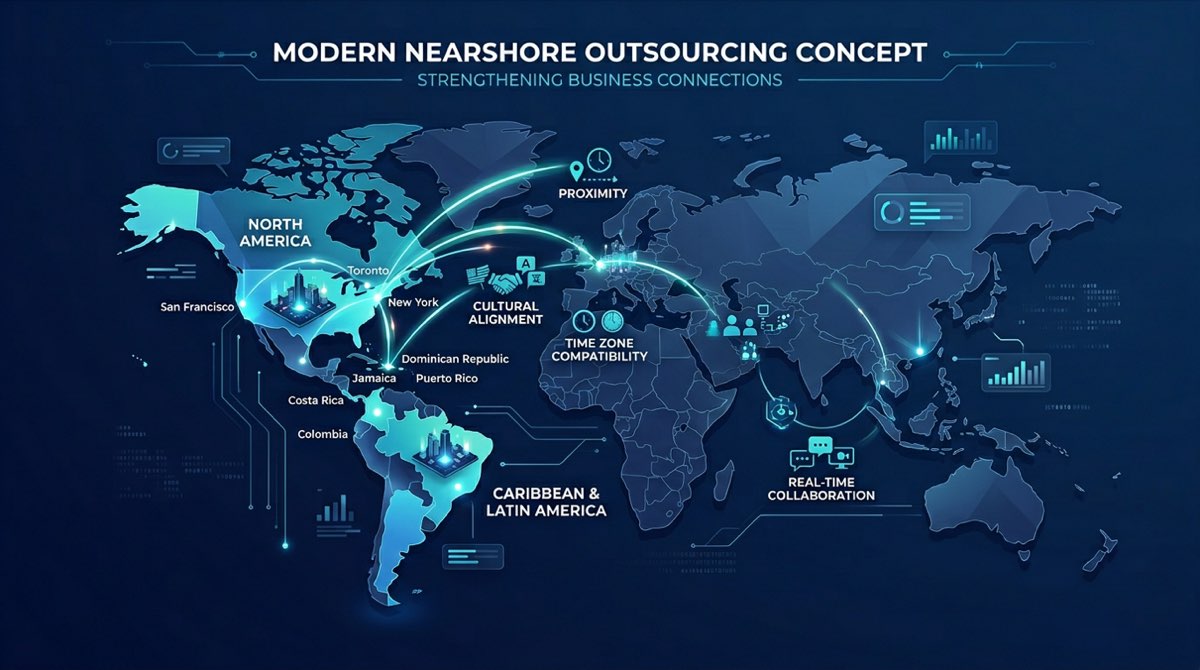
Onshore, nearshore, and offshore are three different organization models for contracting out work to external partners. They vary based on the location of the partner, ease and speed of partnership, expense, and facilities. Here are the essential differences: Onshore outsourcing includes partnering service processes with a business in the exact same country or neighboring town as the customer company.

Latest Posts
Offshore Vs Regional Hubs: a Strategic Review
Understanding Global Law Shifts On Corporate Strategy
Essential Strategies for Successful Global Expansion